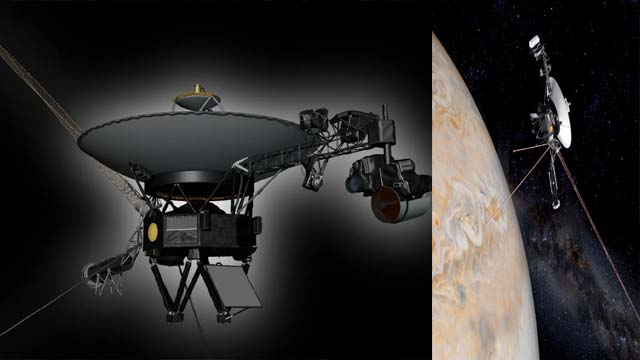
According to the US space agency, NASA, the Voyager 1 probe has been diligently operating for months and is transmitting valuable information back to Earth. This 46-year-old spacecraft holds the distinction of being humanity's most distant object. While a computer glitch had halted the transmission of readable data in November, engineers have successfully resolved the issue.
Currently, Voyager is only sending back data regarding the health of its onboard systems. However, further efforts will be undertaken to reactivate scientific instruments. Situated more than 24 billion kilometers (15 billion miles) away, it takes a full 22.5 hours for radio messages from Voyager-1 to reach us. NASA stated that Voyager-1 is providing updates on the health and condition of its onboard engineering systems. The subsequent phase will enable the spacecraft to commence transmitting scientific data.
Launched from Earth in 1977 to explore the outer planets, Voyager 1 has continued its journey since then. It passed through the heliosphere, the bubble of gas released by the Sun, in 2012 and is currently traversing interstellar space, which contains gas, dust, and magnetic fields from other stars.
Initially, Voyager encountered difficulties when a computer glitch prevented access to a critical section of software code used for packaging transmission data to Earth. Although engineers couldn't retrieve data from Voyager for a period, they observed that the spacecraft was still receiving commands and functioning normally. The issue was resolved by relocating the affected code within the probe's computer memory.
Voyager 1 embarked on its journey from Earth on September 5, 1977, a few days after its companion spacecraft, Voyager 2. Their primary mission was to survey Jupiter, Saturn, Uranus, and Neptune, which they accomplished by 1989. Subsequently, they were directed into deep space, heading towards our galactic center. Powered by radioisotope thermoelectric generators (RTGs) that convert heat from depleted plutonium into electricity, the Voyagers' power output diminishes gradually each year due to the decay process of the generators.
The longevity of the Voyagers remains uncertain, but engineers have devised strategies to extend their operational lifespan by a few additional years. Voyager-2 trails behind its counterpart and moves slightly slower, being only 20 billion kilometers (13 billion miles) from Earth. Despite both spacecraft traveling at 15 kilometers per second (9 miles per second), they won't encounter another star for tens of thousands of years.









Post a comment