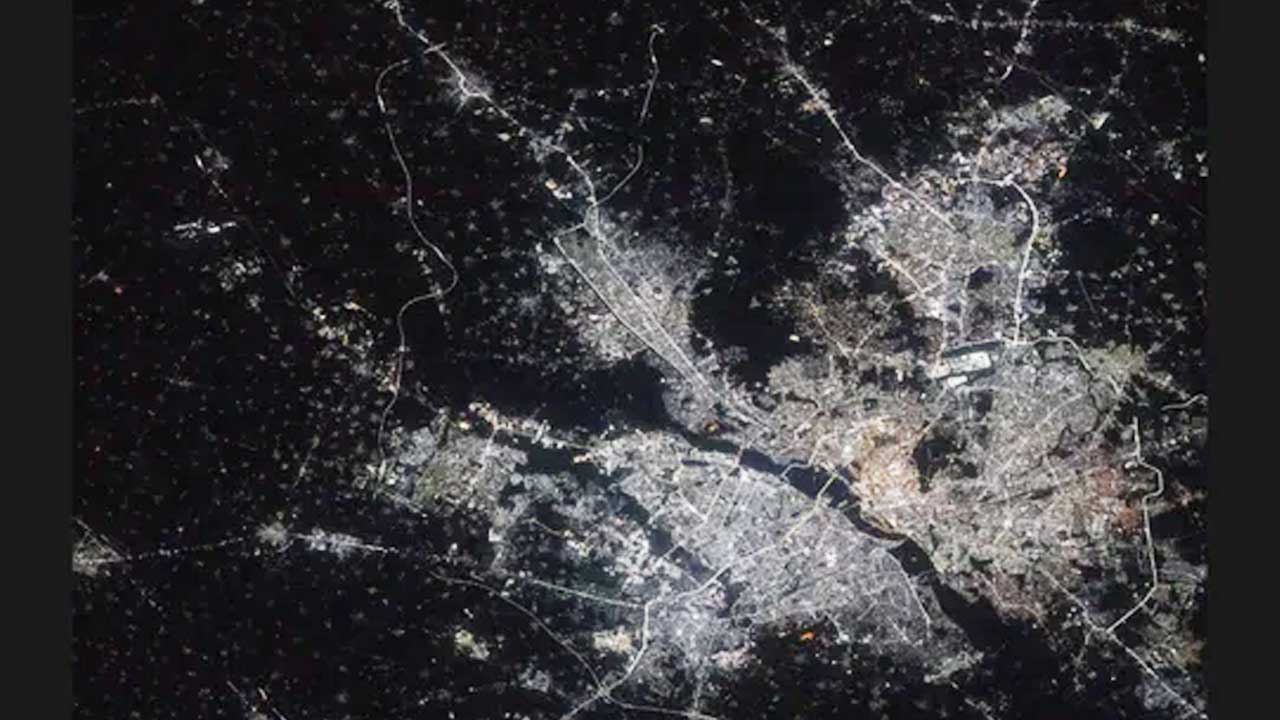
Delhi night view from space
Delhi, India: A recent series of photographs shared on the International Space Station’s official X account highlights some of the world’s brightest cities as viewed from space — and an Indian city stands out among global metros like Tokyo and Singapore. Surprisingly, the city featured is not Mumbai or Bengaluru, but Delhi.
The images capture several major urban regions illuminated at night, with Delhi appearing exceptionally radiant. From orbit, the national capital forms a striking network of lights. The image description notes that the National Capital Territory of Delhi, with an estimated population of about 34.67 million, is the second-largest metropolitan region worldwide, following Tokyo.
According to the ISS, the night photograph was taken at around 10:54 pm local time, showing the Yamuna River dividing the sprawling city. A bright, rectangular patch visible toward the right of the frame is identified as Indira Gandhi International Airport, one of South Asia’s busiest airports.
Other Images Shared by the ISS
- Along with Delhi, the ISS posted nighttime views of:
- Singapore, separated from Malaysia’s Johor Bahru by the narrow Johor Strait
- Tokyo and its neighbouring areas around Tokyo Bay
- The ISS caption stated that cities such as Delhi, Singapore, Tokyo, and Sao Paulo are among the brightest urban landscapes seen from space after sunset.
Social Media Reactions
Users quickly began commenting on the visuals. Some were surprised at Delhi’s glow, referencing the city’s pollution levels, while others admired how clearly the city’s layout appeared from orbit.
Reactions included:
- Delhi still looks so bright despite the pollution?
- I can even locate my own street — stunning!
- That first picture is definitely Delhi; it’s unmistakable.
- My Delhi looks beautiful from up there.
About the International Space Station
The ISS recently celebrated an important milestone on November 2, 2025, marking decades of continuous human presence onboard. The station was conceptualized between 1984 and 1993, and its assembly involved contributions from the United States, Canada, Japan, and various European nations.








Post a comment