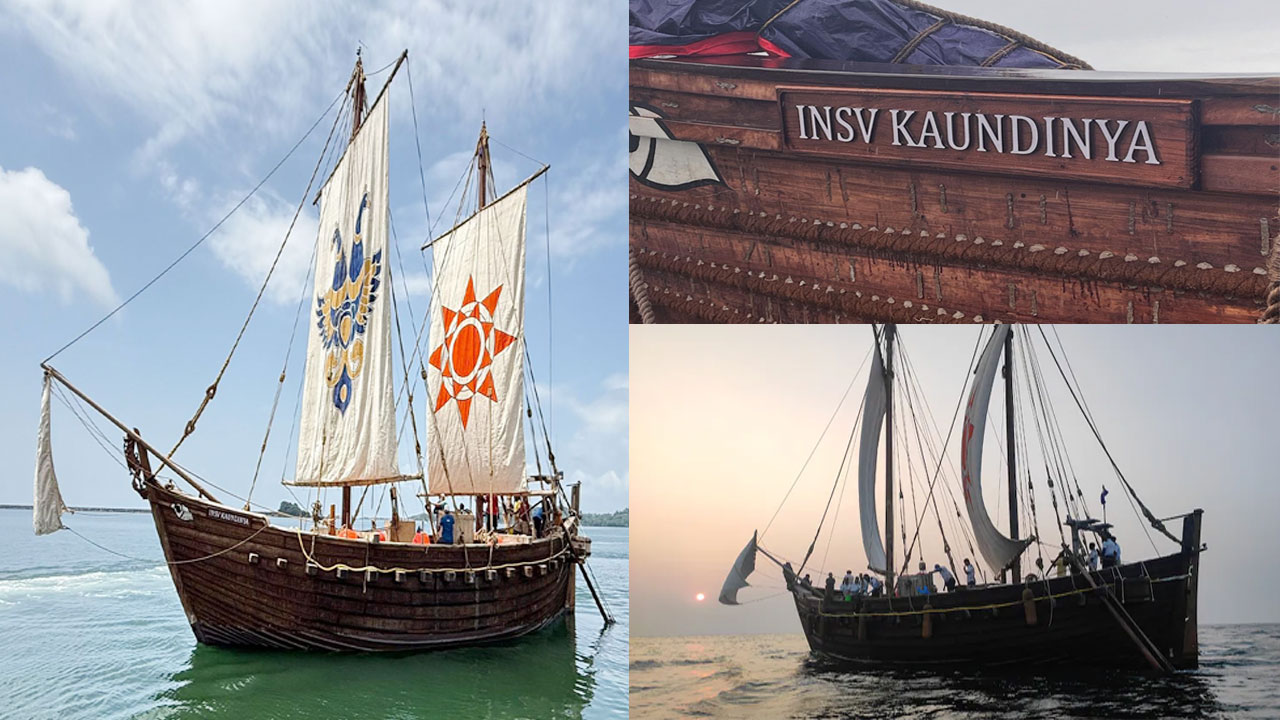
INSV Kaundinya: Inside the Engine-Free Vessel Sailing From India to Oman
Unlike contemporary naval vessels, INSV Kaundinya operates without an engine, metal fasteners, or modern propulsion systems.
The Indian Navy’s INSV Kaundinya is scheduled to begin its historic sea voyage on Monday, departing from Porbandar and sailing to Muscat. The expedition aims to demonstrate and validate India’s ancient maritime knowledge and shipbuilding heritage.
In contrast to modern ships, INSV Kaundinya functions entirely on natural forces. It relies on wind-powered sails and an age-old construction technique that dates back more than 1,500 years, with no use of engines, metal nails, or mechanical propulsion.
What Is INSV Kaundinya?
INSV Kaundinya is a stitched sail vessel constructed using methods believed to have been practiced in India during the 5th century CE. Its design draws inspiration primarily from ship depictions found in the Ajanta cave murals, along with references from ancient Indian literature and accounts written by foreign travelers.
The term “stitched ship” refers to the way its wooden planks are joined together. Instead of iron nails, the planks are sewn using strong coir ropes made from coconut fiber. The hull is sealed with natural resin, cotton, and oils to ensure durability and seaworthiness.
Although the vessel is commissioned under the Indian Navy, INSV Kaundinya is strictly a heritage and research ship and does not serve any combat role.
How INSV Kaundinya Is Constructed
The vessel measures approximately 19.6 meters in length, 6.5 meters in width, and has a draft of nearly 3.33 meters. It is fully sail-powered and is operated by a crew of around 15 sailors.
Its construction follows the traditional Tankai shipbuilding method, an indigenous Indian technique that completely avoids metal components. In this approach, the hull is stitched together first, and the internal ribs are installed later. This structure provides flexibility, allowing the ship to withstand strong ocean waves rather than cracking under pressure.
Key materials used include:
- Wooden planks
- Coir ropes made from coconut fiber
- Natural resins and oils for waterproofing
Who Built INSV Kaundinya?
The initiative began in July 2023 through a collaborative agreement involving the Ministry of Culture, the Indian Navy, and Hodi Innovations, with financial support from the Ministry of Culture.
A group of traditional shipbuilders from Kerala, led by master craftsman Babu Sankaran, assembled the vessel entirely by hand. Since no original blueprints existed, the Indian Navy reconstructed the design using visual references and historical descriptions. Scientific evaluations, including hydrodynamic testing at IIT Madras, were conducted to confirm the ship’s safety and performance.
The ship was launched in February 2025 and was officially inducted into naval service in May at Karwar.
Meaning of the Symbols on INSV Kaundinya
- INSV Kaundinya features several symbols that reflect India’s maritime and cultural legacy:
- Gandabherunda, the twin-headed eagle associated with the Kadamba dynasty
- Sun symbols displayed on the sails
- Simha Yali, a mythical lion-like figure positioned on the bow
- A stone anchor inspired by Harappan designs placed on the deck
Who Was Kaundinya?
The ship is named after Kaundinya, a mariner from the 1st century CE. Historical records from Southeast Asia and China state that he sailed to the Mekong Delta, married Queen Soma, and played a key role in founding the Kingdom of Funan in present-day Cambodia.
Funan became one of the earliest regions influenced by Indian culture in Southeast Asia. The Khmer and Cham dynasties are believed to trace their lineage to this union. While Indian historical texts do not document Kaundinya, he is widely regarded as the earliest known Indian sailor to leave a lasting global historical imprint.
Why This Voyage Matters
The sea route linking India to Oman and further into Southeast Asia once served as a vital commercial and cultural corridor. Indian traders and sailors used these waters to exchange spices, textiles, and knowledge with West Asia, Africa, and Southeast Asia. By navigating this historic path once again, INSV Kaundinya is symbolically reconnecting India with its ancient maritime trade networks.










Post a comment