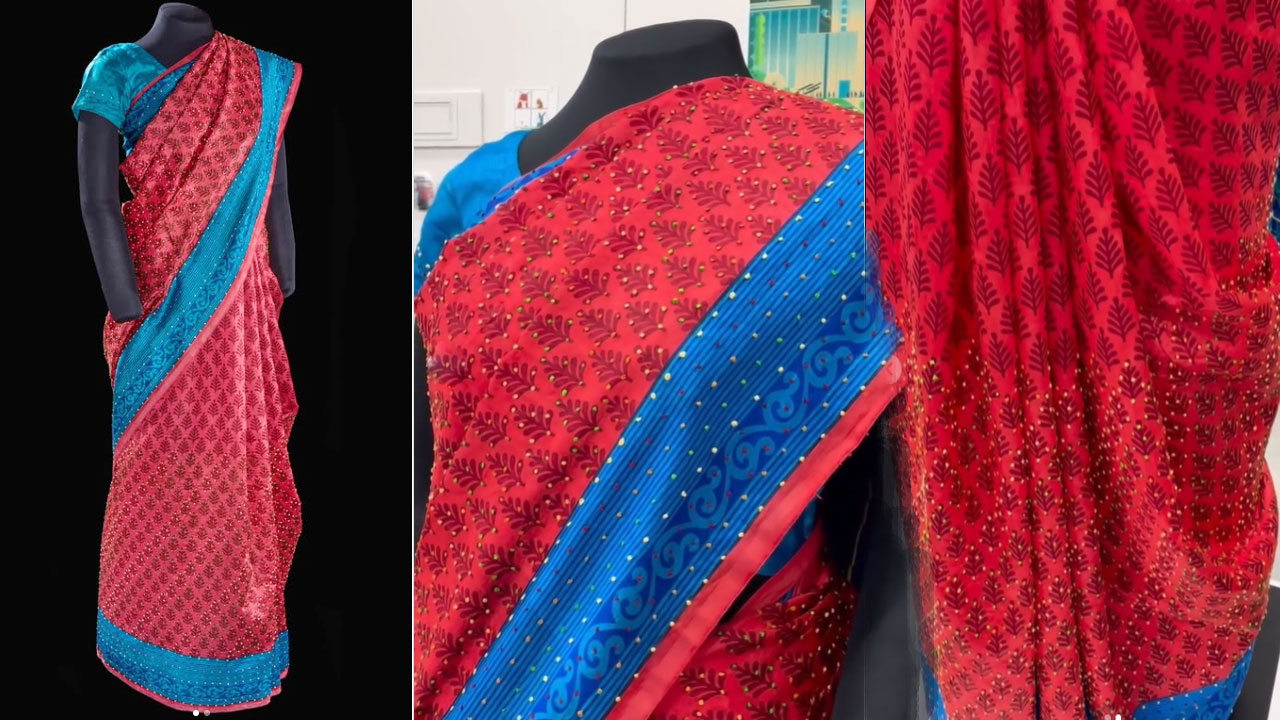
Nandini Harinath Saree at Smithsonian Museum
Washington, D.C., USA: The Smithsonian National Air and Space Museum, widely known for showcasing historic aircraft and space exploration artifacts, has now added a unique symbol of India’s scientific achievement to its collection - a saree worn by renowned ISRO scientist Nandini Harinath.
Nandini Harinath played a crucial role in India’s historic Mars Orbiter Mission, popularly known as Mangalyaan. Coming from a family with strong academic roots — her father being a mathematical engineer and her mother a mathematics teacher - she pursued engineering before joining the Indian Space Research Organisation. Over a career spanning more than two decades, she contributed to over 14 major space missions.
Speaking in earlier interviews, Nandini described Mangalyaan as one of the most memorable achievements of her career. She said the mission brought global recognition to India’s scientific capabilities, with congratulatory messages coming from both the Indian Prime Minister and NASA. According to her, the mission also opened new opportunities for collaboration between India and international space agencies.
Nandini also revealed that her fascination with space exploration began during childhood after watching the popular television series Star Trek. She mentioned that her entire family followed the show regularly, which inspired her interest in science and space research. She also cited the Hollywood film Apollo 13 as one of her favourite movies, praising its message of teamwork and determination.
The saree displayed at the Smithsonian Museum carries symbolic significance. ISRO launched the Mars Orbiter Mission on November 5, 2013, and the spacecraft successfully entered Mars orbit on September 24, 2014, making India the first Asian nation to achieve the feat on its maiden attempt.
In an Instagram post, the museum explained that the saree represented both India’s cultural identity and the achievements of women scientists who led the mission. The outfit featured a blue jacket paired with a red-and-blue draped saree design. The museum also shared photographs and a video highlighting the importance of the artifact in India’s space history.









Post a comment