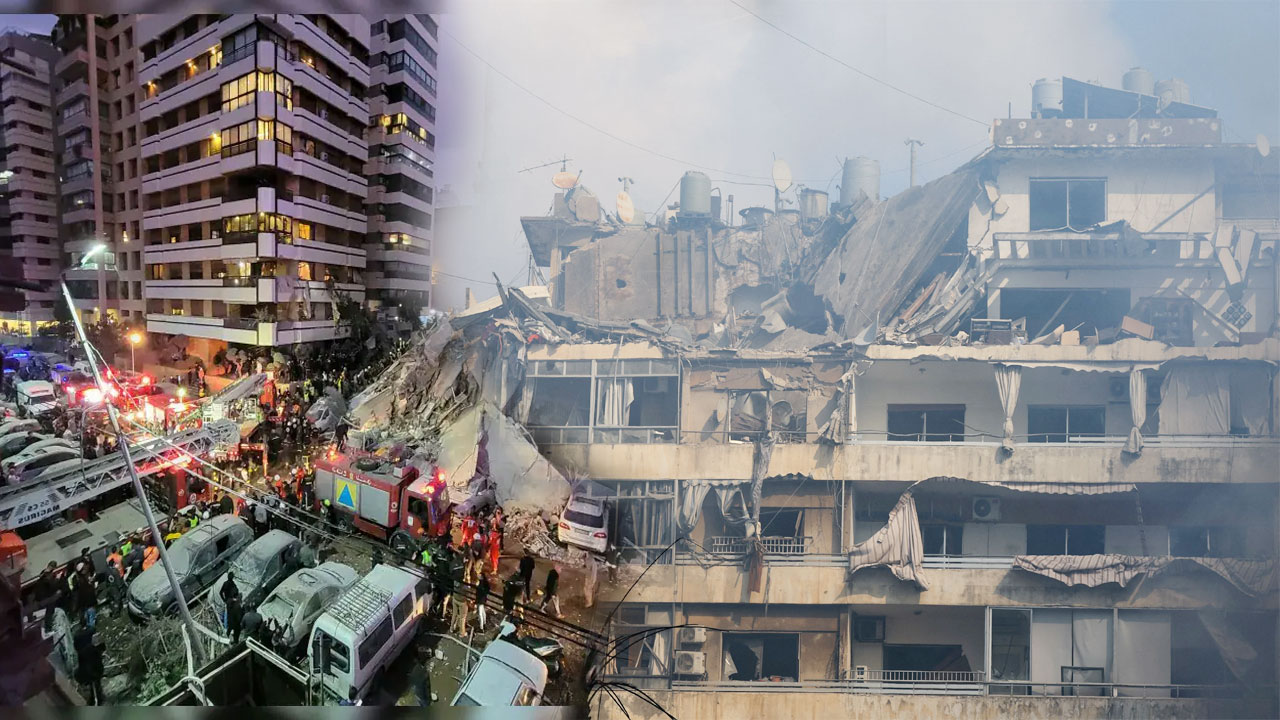
Israeli airstrikes in Beirut amid US-Iran ceasefire tensions
Tehran: A fragile ceasefire between the United States and Iran is facing serious uncertainty as escalating Israeli military operations in Lebanon threaten to derail ongoing diplomatic efforts in the Middle East.
The situation intensified after Iran once again closed the strategically significant Strait of Hormuz, a crucial global oil transit route. The move comes in response to Israel’s expanded airstrikes targeting Hezbollah positions in Lebanon. The United States, under President Donald Trump, has urged Iran to reopen the waterway to avoid disruptions to global energy markets and preserve ongoing negotiations.
Although Washington and Tehran had earlier presented the Pakistan-mediated two-week ceasefire as a diplomatic breakthrough, hostilities have continued. Missile and drone exchanges have impacted Iran and Gulf nations, while Israel has significantly escalated its offensive in Lebanon.
Escalation in Lebanon
Israel launched a large-scale and coordinated military offensive, striking more than 100 Hezbollah-linked targets across Beirut, the Bekaa Valley, and southern Lebanon within a short span of time. Several residential areas in Beirut suffered heavy damage.
According to Lebanon’s civil defence authorities, at least 254 people have been killed and over 1,100 injured, with most casualties reported in the capital. Critical infrastructure has also been affected, including the destruction of a major bridge over the Litani River, isolating parts of southern Lebanon.
Israeli officials have alleged that Hezbollah operates within civilian areas, a claim denied by local authorities and residents. Evacuation orders now extend to nearly 15% of Lebanese territory, displacing approximately 1.2 million people.
Dispute Over Ceasefire Scope
A key issue remains whether Lebanon is included under the ceasefire agreement. Iranian Foreign Minister Abbas Araghchi has stated that the truce covers Lebanon, while Israeli Prime Minister Benjamin Netanyahu and US officials have rejected this claim.
This disagreement has further strained diplomatic relations, with Iran accusing the United States of failing to uphold commitments. Tehran has also raised concerns over continued Israeli military actions and alleged violations of its airspace.
Strategic and Political Tensions
The White House has strongly criticized Iran’s closure of the Strait of Hormuz, calling it unacceptable due to its importance for global trade. Additional tensions have emerged over Iran’s proposal to impose transit tolls on vessels passing through the route.
US Defense Secretary Pete Hegseth described recent developments as a strategic success, claiming reduced Iranian threat capabilities. However, Iranian officials argue that their actions forced both the United States and Israel into concessions.
With ongoing military activity and lack of clarity over ceasefire terms, uncertainty continues to grow. Analysts warn that without restraint and clear agreements among all parties, the fragile truce risks collapsing, potentially triggering a wider regional conflict.









Post a comment